
Sandwich ELISA test
Introduction
An ELISA (Enzyme-Linked Immunosorbent Assay) is a biochemical analytical technique used to measure the concentration of proteins or other biomolecules. The method relies on the interaction between an antibody and its corresponding antigen. An enzyme-linked detection method is then used for the conversion of a substrate, which can be measured by a spectrophotometer for instance. By using calibrator material of the antigen, this method enables quantitative measurements. Among immunoassay formats, the ELISA is widely used in both clinical diagnostics and research due to its accessibility, reliability, and applicability to a broad range of samples, including serum and plasma.
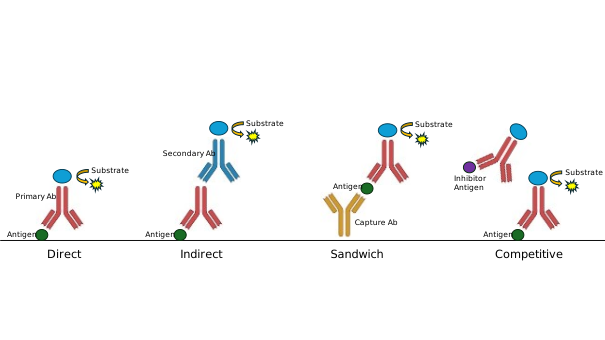
Direct, indirect, and competitive ELISA are also commonly applied ELISA formats. In a direct ELISA, the antigen is immobilized on the surface or in a solid phase, and a single enzyme-labeled primary antibody binds directly to the target. In an indirect ELISA, the antigen is also plate-bound, but detection occurs through an unlabeled primary antibody followed by an enzyme-conjugated secondary antibody. In a competitive ELISA, the sample antigen and a labeled antigen compete in solution for a limited number of antibody-binding sites. As the sample antigen concentration increases, less labeled antigen becomes immobilized on the plate, resulting in lower color development. Figure 1 illustrates how the different methods are structured.
In a sandwich ELISA setup, the target antigen is first captured by an immobilized antibody, after which a second enzyme-labeled antibody binds to a different epitope on the same antigen. The binding of a second enzyme-labeled antibody can also be used in the indirect ELISA setup. When the enzyme subsequently interacts with its chromogenic substrate, a measurable color signal is generated. The intensity of this signal is directly proportional to the concentration of the antigen present, provided that a standard or sample with a known concentration is available to calibrate the OD signal.
The sandwich ELISA is particularly well-suited for detecting low-abundance biomarkers in complex biological samples. It can be a highly sensitive and specific method when the correct reagents are used and the assay is properly validated. Hycult Biotech offers a wide range of assays with high specificity and sensitivity due to the strict development and validation protocols we follow.
Materials and Reagents
- Coating antibody (1-10 µg/ml in coating buffer)
- Options coating buffer:
- Carbonate buffer: 100 mM NaHCO3/Na2CO3 (pH 9.5-9.7)
- PBS buffer: 4,3 mM Na2HPO4, 1,0 mM KH2PO4, 154,0 mM NaCl (pH 7.3-7.5)
- Options blocking buffer:
- PBS + 1% BSA
- PBS + 1% Caseïne
- Options coating buffer:
- Standard, controls and/or samples, serving as reference
- Primary antibody (e.g. unlabeled/biotinylated/Horseradish peroxidase/etc.)
- Enzyme labeled secondary antibody (e.g. Streptavidin-HRP)
- Wash buffer: PBS + 0,05% Tween-20 (pH 7.2-7.6)
- Dilution buffer: PBS + 0,1% BSA (pH 6.8-7.6)
- Substrate
- Stop solution: 2% oxalic acid
Procedure
Before the assay, both antibody preparations should be purified and serum-free. In addition, the detection antibody must be labeled (e.g. biotinylated/horseradish peroxidase).
Coating with capture antibody
- Coat the wells by adding 100 µl of coating antibody solution to each well. The amount of antibody used is customizable. Optimize the coating concentration (1-10 µg/ml) for the most sensitive assay setup.
Blocking
- The remaining sites for protein binding on the microtiter plate must be saturated by incubating the wells with blocking buffer. Fill the wells with 150 µl/well blocking buffer. Incubate for 60-90 minutes at room temperature or overnight at 4°C.
- Wash wells four times with wash buffer before sample incubation.
Sample incubation
- Add 100 µl of the diluted standards, samples and controls to the wells. All dilutions should be done in the dilution buffer.
- Cover the plate with adhesive plastic and incubate for 30-60 minutes at room temperature or at 37°C.
- Wash the plate four times with wash solution.
Primary antibody incubation
- Add 100 µl of the (labeled) primary antibody.
The amount to be added can be determined in preliminary experiments. For accurate quantification, the primary antibody should be used in excess. All dilutions should be done in the dilution buffer.
- Cover the plate with adhesive plastic and incubate for 30-60 minutes at room temperature or at 37 °C.
- Wash the plate four times with wash buffer.
In case of no horseradish peroxidase: Incubation with the secondary antibody (or Streptavidine-HRP in case of biotinylated primary antibody)
- Add 100 µl of the labeled secondary antibody.
The amount to be added can be determined in preliminary experiments. For accurate quantification, the labeled secondary antibody should be used in excess. All dilutions should be done in the dilution buffer.
- Cover the plate with adhesive plastic and incubate for 30-60 minutes at room temperature or at 37 °C .
- Wash four times with wash solution.
Substrate and stop solution incubation
- Add the substrate.
- After suggested incubation time has elapsed, add 100 µl of the stop solution to each well.
- Optical densities at target wavelengths can be measured on a spectrophotometer within 30 minutes after adding stop solution.
Analysis of the data
- Calculate the average absorbance values for each set of duplicate standards, samples and controls.
- If individual absorbance values differ more than 15% from the corresponding mean value, the result is considered suspect and the sample should be re-assayed.
- Create a standard curve by transferring the data to computer software capable of generating a good curve fit (4-PL curve fit). On our website you can find ELISA calculation sheets.
- If the samples have been diluted, the concentration determined from the standard-curve must be multiplied by the dilution factor.
Safety
• Hycult Biotech cannot be held liable for any damages resulting from the use of this protocol. Users are expected to be properly trained and familiar with the test procedures.
• Samples of tissue, serum, or blood origin must be handled according to established biosafety guidelines to prevent transmission of bloodborne pathogens.
• Certain enzyme substrates may pose health hazards, including potential carcinogenicity. Handle these materials with caution and consult the corresponding Material Safety Data Sheets (MSDS) for detailed safety instructions.
• Always wear suitable protective equipment to prevent accidental contact with reagents (such as lab coats, gloves, and safety goggles).
• Exercise particular caution when working with reagents containing substances known to be dangerous.
• Some reagents may contain preservatives that are toxic if ingested, inhaled, or absorbed through the skin. Avoid exposure and follow standard laboratory safety practices at all times.
Calculate your ELISA data easily
With the ELISA calculator you can easily calculate ELISA data. Assayfit Pro helps to perform curve fitting. The calculator generates advanced reports, fit graph, fit parameters and goodness of fit are shown.
We are glad to support you!
Take advantage of our dedicated support team for any technical assistance you need while using our products or considering them for your research needs.