
Custom concentrations and volumes possible starting from 0.5 mg More info
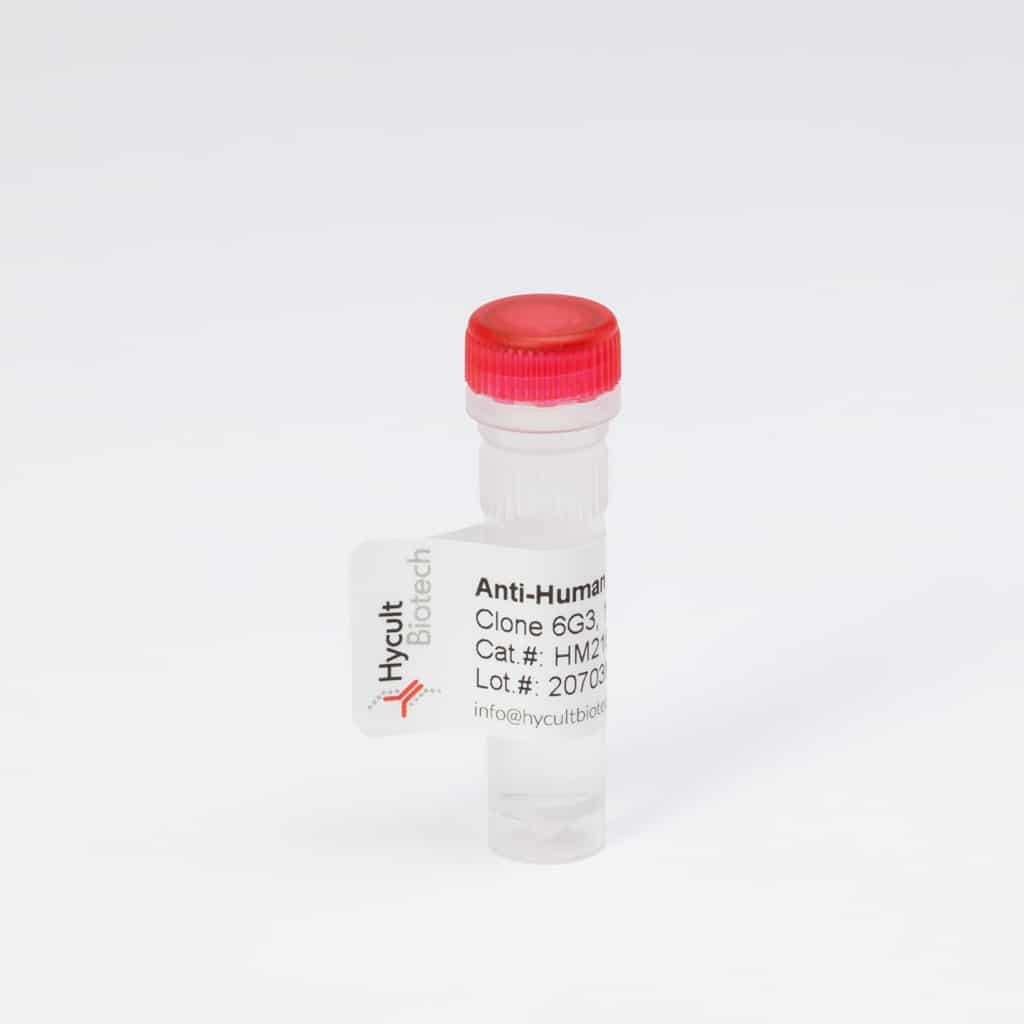
FH & FHRs, Human, mAb L20/3
Monoclonal antibody L20/3 recognizes human complement FH &FHRs and is suitable for use in immunoassays and Western blot.
Read more€139.00 €431.00Price range: €139.00 through €431.00
Monoclonal antibody HM2249 clone L20/3 recognizes human complement factor H and FHR proteins (FHR-1, FHR-2, FHR-4 and FHR-5) through recognition of the SCR20 domain.
The complement system is a key component of the immune response that defends against infections, initiates inflammation, manages immune complexes and regulation of immune responses. Complement factor H (CFH or FH) is the principal regulator of the alternative pathway, ensuring that complement activation is restricted to appropriate targets. Unlike the classical and lectin pathways, the alternative pathway is constitutively active at a low level and therefore requires tight control. CFH exerts this control by binding to C3b, accelerating decay of the C3 convertase (C3bBb), and acting as a cofactor for Complement factor I-mediated cleavage of C3b. In addition, CFH inhibits convertase formation by competing with factor B. Through these mechanisms, it regulates complement both in fluid phase and on host cell surfaces.
Structurally, CFH is a ~150 kDa plasma glycoprotein composed of linearly arranged 20 short consensus repeat (SCR) domains (also called complement control protein (CCP) modules). These domains confer multiple ligand-binding sites, including three regions for C3b and several for polyanions such as glycosaminoglycans. Functionally, CFH is organized into two main regions: the N-terminal SCR1–4 domains mediate complement regulatory activity, while the C-terminal domains, particularly SCR19–20 with contribution from SCR7, enable recognition of host surfaces via binding to C3 fragments and polyanions. This dual architecture allows CFH to selectively protect self-tissues from complement-mediated damage.
CFH is part of a protein family that includes the complement factor H-related (FHR) proteins (FHR-1, FHR-2, FHR-3, FHR-4, FHR-5), which share a similar SCR-based structure and high sequence homology, particularly in domains corresponding to CFH surface-recognition regions. Unlike Factor H-like protein 1 (FHL-1), FHR-1 – 5 proteins lack domains equivalent to CFH SCR1–4 and therefore generally lack intrinsic complement regulatory activity. Instead, they are thought to modulate complement by competing with CFH for ligand binding.
Complement factor H-related protein 1 shows the closest similarity to CFH (see figure 1). Its C-terminal domains are highly homologous to CFH SCR19–20, enabling binding to similar ligands such as C3b and polyanions. However, lacking regulatory domains, FHR-1 can displace CFH from surfaces without inhibiting complement activation, potentially promoting local amplification. This competitive interaction is enhanced by FHR-1 dimerization.
Dysregulation of the CFH–FHR balance is associated with diseases including Atypical hemolytic uremic syndrome, C3 glomerulopathy (aHUS), and age-related macular degeneration (AMD), highlighting the clinical importance of this regulatory network.
The epitope of antibody clone L20/3 is described to be located within SCR20. This epitope is present in FH and all FHRs. However, FHR-3 is not recognized in BLI analysis. Antibody is, at least but not limited to, applicable in the following applications: ELISA, BLI and western blotting. Please, Contact Hycult Biotech for further information.

 Powered by Bioz
You may also like…
You may be interested in…
-
View product €139.00 €431.00Price range: €139.00 through €431.00
-
View product €139.00 €431.00Price range: €139.00 through €431.00
-
View product €139.00 €431.00Price range: €139.00 through €431.00
-
View product €139.00 €431.00Price range: €139.00 through €431.00